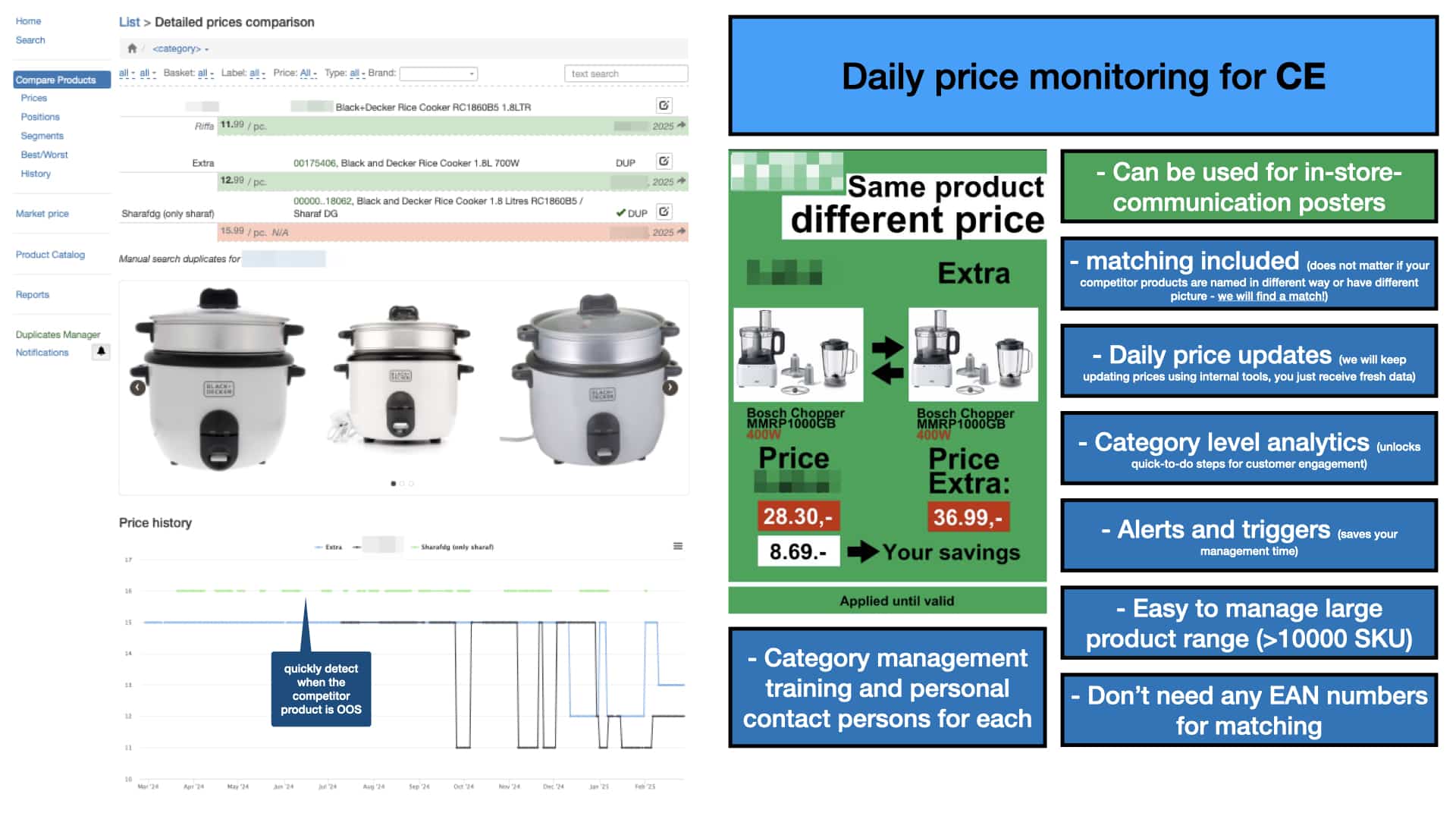
Same product
Equivalent SKU sold by different webshops under different names, URLs, pictures or internal product codes.







 Estimate scope
Product matching
Matching is the difference between a raw crawler and usable price intelligence. Getrealprice can connect equivalent products across names, images, codes, marketplaces and country-specific catalogs.
Why it matters
A product may appear under different names, sizes, pictures or seller structures. Matching turns those listings into comparable market signals.
Equivalent SKU sold by different webshops under different names, URLs, pictures or internal product codes.
A stricter matching route for the same product where differences are mainly presentation and source structure.
Used more carefully when exact equivalence is not possible but a commercial comparison is still useful.
After the first matching wave, the service can keep catching new matches as catalogs change.
Commercial workflow
Initial cooperation can compare a large part of the client catalog against competitors. Later months often focus on new arrivals, match corrections and changed product ranges.
The number of products, source complexity and match type affect both workload and service cost.